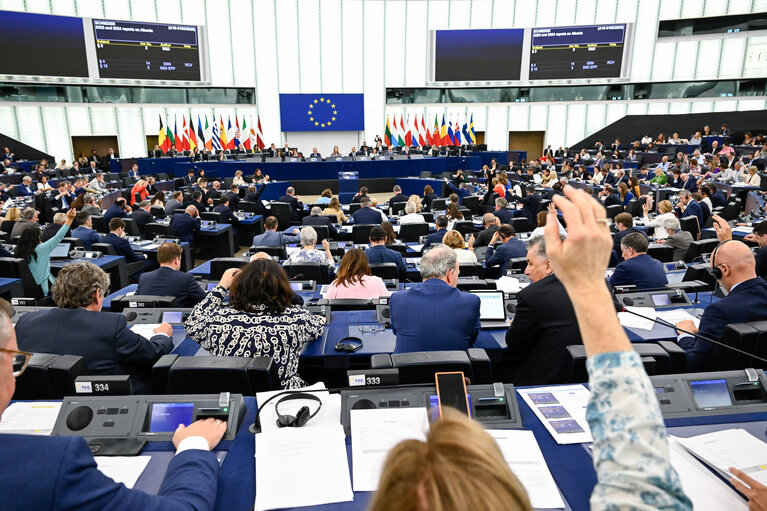
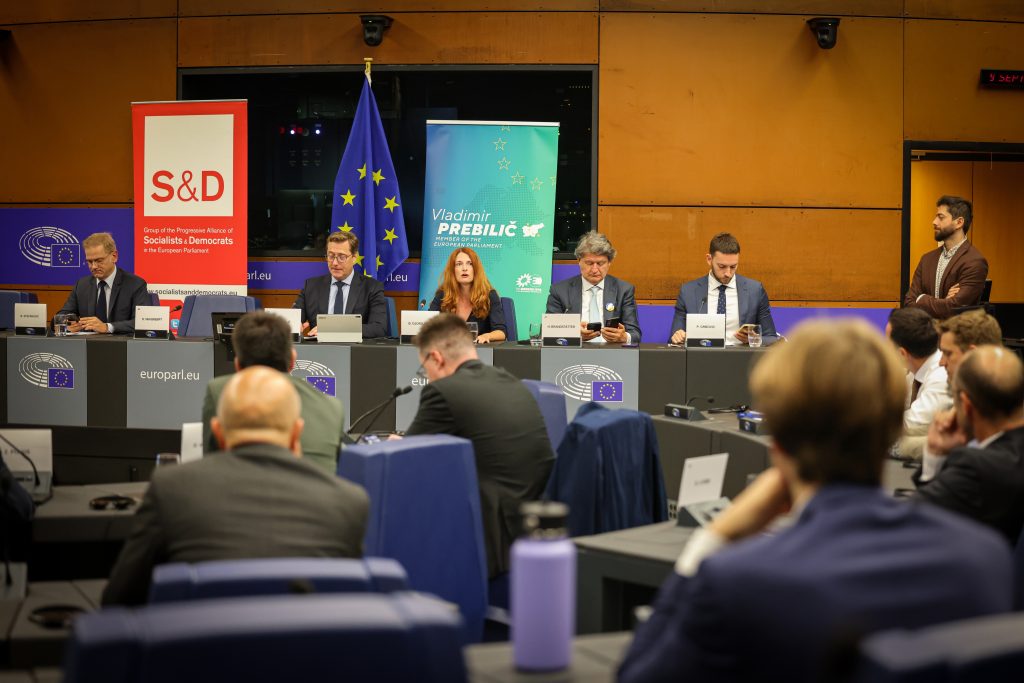
STRASBOURG – The demand for early elections in Serbia is a call for a peaceful transition of power, and the European Union should stop treating Aleksandar Vučić as a European, democratic leader and instead recognize him as an autocrat, a “Serbian Lukashenko”. This was one of the conclusions of the panel “Serbia – Democracy at a Crossroads” held in the European Parliament, at which the Serbian opposition spoke.
Member of the European Parliament Vladimir Prebilič (Greens/EFA) stated that one of the conclusions of today’s debate was that the European Commission should consider suspending financial support to Serbia if the situation does not change soon, and even impose sanctions on individuals ordering violence against demonstrators.
Prebilič added that the European Parliament could send a mission to Serbia to assess the situation on the ground, while also increasing pressure on the European People’s Party over the membership of the Serbian Progressive Party.
“We are asking the European Commission to reconsider further financial support for Serbia if nothing changes soon,” he said.
He also announced the possibility of greater support for independent media, “because without free media there can be no democracy, nor progress for Serbia on its path toward the EU”.
“Serbia must and should become a member of the European Union, but it cannot do so under the regime of President Aleksandar Vučić, who beats and wiretaps people”, said Helmut Brandstätter, MEP from the Renew Europe group, speaking today in the European Parliament.
Brandstätter thanked European Commissioner for Enlargement Marti Kos for her clarity and said he expects the same from all members and the leadership of the European Commission.
Deputy leader of the Freedom and Justice Party, Borko Stefanović, said his party advocates early elections at all levels except the presidential. He stressed the importance of unity in this demand, clarifying that this does not mean a single electoral list but coordinated action among all actors — students, citizens, and civil society organizations.
“These elections must be at least partly free and democratic, to the extent we can implement ODIHR and OSCE recommendations,” Stefanović said.
Biljana Đorđević, co-president of the Green–Left Front (ZLF), also supported early elections, warning that without stronger condemnation from the European Union of violence and repression in Serbia, the situation could escalate further.
She presented details from the ground in Serbia, including cases of police brutality, the dismissal of education workers, and the use of sonic weapons at the rally on 15 March.
Đorđević reiterated her party’s and the Free Citizens Movement’s demands, also conveyed to EU High Representative Kaja Kallas, calling for a clear condemnation of police brutality and illegal paramilitary groups, as well as EU pressure on the Serbian government to stop falsely accusing people of terrorism and attempts to overthrow the constitutional order.
During the debate, Pavle Grbović, leader of the Free Citizens Movement, pointed out that several people of his party have been arrested.
“You will not see EU flags on the streets, but you will see people fighting for true European values. And that is why citizens rightly expect those who stand for these values to support them. These values do not come from China or Russia — they come from the EU,” Grbović stressed.
Zdravko Ponoš, leader of the Serbia Center party, emphasized that while Serbia is formally on the European path, the country is moving in the wrong direction.
“We now have the chance to stop this decline before it turns into free fall,” Ponoš said, noting that Serbia, as the largest country in the region, has the potential to influence developments positively or negatively.
“Stabilitocracy no longer works in Serbia. And to those in the EU who worry about what comes after Vučić, don’t. There will be no vacuum. We will have a political, democratic process. There is no reason to be disappointed in today’s Serbia, because it is clear that Vučić is not Serbia”, Ponoš assessed.